
“Why aren’t we seeing the progress we expected?”

By the time organisations come to us, they often already have the data, strategy, action plans, staff networks, training programmes and reviews in place. Yet many are still wrestling with a different question: to what extent are we addressing the conditions that produce these outcomes, versus the issues they make visible?
We observed a recurring pattern.
Many organisations could describe the actions they had taken. Many could point to initiatives, interventions and commitments designed to address systemic racism. Yet there was often less certainty about what was actually producing the outcomes they were trying to change.
That observation became the foundation of our work and ultimately led to the development of a structured organisational examination process designed to help organisations address the structural roots of systemic racism.
Uncovering the Design Behind Systemic Racism
Built around the Four-Factor RACE Model™ first introduced in the best-selling book The Anti-Racist Organization: Dismantling Systemic Racism in the Workplace, the five-stage organisational examination process provides a structured way for groups of people to collectively examine how organisational decisions, accountability, behaviours and ways of working may be contributing to the outcomes they are trying to change.
The process can be used with leadership teams, HR functions, staff networks, operational teams and other colleague groups seeking to identify, once and for all, what is about the way the organisation is working that continues to cause disparities in experiences, opportunities and ultimately outcomes.
Is this for every organisation?
Probably not.
Only because you must be in a place to act.
Whilst the organisational examination process can be used in a wide range of settings, it is particularly suited to organisations that have already been trying to address systemic racism and are still asking themselves:
What are we missing?
Examples of our work
30 Patterns of Harm: A Structural Review of Systemic Racism within the London Metropolitan Police Service
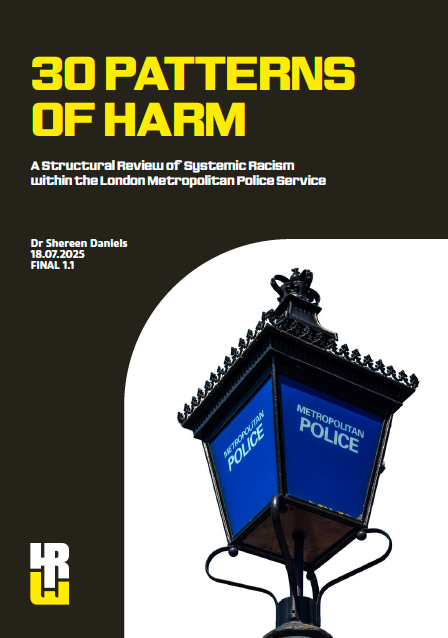
The Metropolitan Police Service (MPS) has today [7/11/2025] published an independent report by Dr Shereen Daniels, commissioned by the MPS to examine how the organisation has responded to long-standing evidence of racism and discrimination. The report was commissioned to assess the effectiveness and impact of the ‘London Race Action Plan’, the Met’s strategic framework for becoming an anti-racist organisation.
Source: Metropolitan News
The Met welcomes the report in full and recognises the scale of the challenges it sets out. This is a moment that calls for reflection, and further change. Becoming an anti-racist police service is not just the right thing to do, it is essential to building trust, improving operational effectiveness, and keeping Londoners safe. Tackling racism and discrimination remains a key priority in the New Met for London Plan. Sustainable change means addressing deep-rooted problems, not offering surface-level fixes.
Source: Metropolitan NewsLatest Article
"Inclusion" Cannot Fix the Structural Roots of Systemic Racism

“Racism needs specific intervention. Taking a generalised approach to a specific problem never yields impressive results.”
In 2012, I was diagnosed with stage four Hodgkin’s lymphoma, a particular type of blood cancer.
I remain deeply grateful for the care I received from the NHS team who eventually treated me at Darent Valley Hospital in Kent, where I live. Their expertise, led by an incredible consultant, Dr Shafi, who has since sadly passed away from Covid-19, quite literally saved my life.
When I wrote The Anti-Racist Organization, published in 2022, I made a very clear point about the importance of being specific when addressing systemic racism in the workplace. I rarely centre my own personal stories in my work on systemic racism, but in this case, I did. And I did it deliberately.
Not because I wanted a compelling anecdote, but because it illustrates a principle that, frankly, I feel like we are conveniently forgetting time and time again.
Those of you who have read the book may remember the section on pp. 150 to 153 where I recount that story.
For those of you who haven’t, the short version is this.