
"Inclusion" Cannot Fix the Structural Roots of Systemic Racism

“Racism needs specific intervention. Taking a generalised approach to a specific problem never yields impressive results.”
In 2012, I was diagnosed with stage four Hodgkin’s lymphoma, a particular type of blood cancer.
I remain deeply grateful for the care I received from the NHS team who eventually treated me at Darent Valley Hospital in Kent, where I live. Their expertise, led by an incredible consultant, Dr Shafi, who has since sadly passed away from Covid-19, quite literally saved my life.
When I wrote The Anti-Racist Organization, published in 2022, I made a very clear point about the importance of being specific when addressing systemic racism in the workplace. I rarely centre my own personal stories in my work on systemic racism, but in this case, I did. And I did it deliberately.
Not because I wanted a compelling anecdote, but because it illustrates a principle that, frankly, I feel like we are conveniently forgetting time and time again.
Those of you who have read the book may remember the section on pp. 150 to 153 where I recount that story.
For those of you who haven’t, the short version is this.
Before I was finally diagnosed, I spent months being misdiagnosed, passed between different GPs, pharmacies and specialist appointments, trying different treatments and paying an extortionate amount for medication that didn’t work because no one had yet identified what the underlying condition actually was.
When the correct diagnosis finally arrived, it was almost too late.
By that point, I was already stage four.
Thankfully, I eventually came under the care of Dr Shafi, a haematologist specialising in blood cancers: " You are very, very sick, young lady, but I am going to do everything I can to fix that.”
And that is exactly what he did.
What I also remember very clearly is what didn’t happen.
There were no debates about whether I was better off under the care of my GP and then “see what happens”.
That would have been ridiculous.
In medicine, specificity matters.
If someone has Hodgkin’s lymphoma, you bring in a specialist who understands Hodgkin’s lymphoma. You do not ask a general practitioner to lead the treatment of stage four blood cancer simply because they also work in healthcare.
My GP continued to play an important role in my care, but he was not the person leading the intervention. That responsibility sat with the specialist who understood that particular disease.
Do you see what I'm saying?
When specific problems are generalised
Even though we claim to understand the principles of why specific intervention is needed, time and time again, when organisations are confronted with systemic racism, particularly as it impacts Black colleagues, communities and consumers, the instinct is to broaden the frame rather than sharpen it.
Which brings me to the London Metropolitan Police.
The proposal currently being consulted on would move work that has explicitly focused on anti-Black racism and racial harm experienced by Black Londoners into a broader anti-discrimination or inclusion strategy so they can address other forms of harm "more easily".
Before going any further, let me say something clearly because this is where people often misunderstand the point.
Acknowledging anti-Black racism does not mean pretending other groups do not experience discrimination. Of course they do. People encounter institutions through multiple aspects of their identity and their way of life.
But recognising that reality is not the same as pretending all harms are produced in the same way.
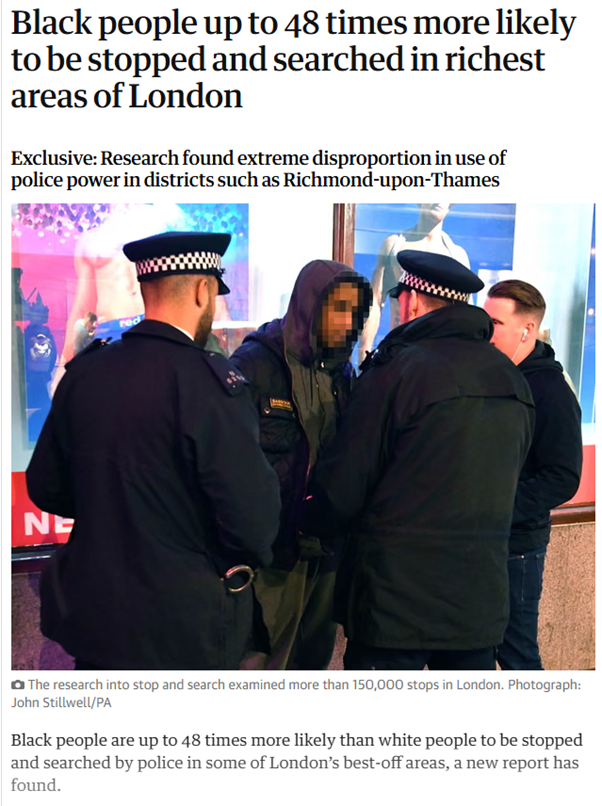
Anti-Black racism within British policing has a very long, very well-documented history. From Scarman, to Macpherson, to Casey, and most recently through the work I carried out in 30 Patterns of Harm, there is a substantial body of evidence showing that the experiences of Black communities and Black officers and staff reveal a lot about how policing is designed and how it operates, despite good intentions and busy activity.
Addressing systemic racism in organisations or policing institutions that have a long history of harming Black colleagues, communities, and consumers is not preferential treatment. Particularly when it is in response to documented evidence.
My work has never called for increasing representation as a cure, or a focus on inclusion to address racialised harm, violence and in some instances, death.
The work is that serious.
Thus, when I am reviewing what an organisation wants to do, or what it stands for in relation to how everyone should experience it, the most reliable indicator (by definition of available data) of organisational health, if you like, is the gap between what an organisation says it stands for and what people actually experience when they come into contact with it.
That gap is not evenly distributed. In the case of the Met police, Black officers, staff, volunteers, and Black communities experience the sharpest edge of institutional failure, not because we are uniquely problematic, but because we sit at the point where discretion, suspicion, power, credibility, and protection are most unevenly applied. This is why the Black experience functions as a stress test. It is where the Met’s weaknesses are most visible.
If strategic and targeted reform does not close the gap here, it will not close it anywhere. Why? Because the underlying fault lines remain intact.
This is where the conversation about intersectionality often becomes confused
When I carried out the structural review into systemic racism within the Metropolitan Police, I deliberately chose not to treat intersectionality as a list of protected characteristics. Usually, the conversation goes something like this: someone is Black and a woman, or Black and disabled, or Black and LGBTQ+, and those identities are treated as separate characteristics that add up to a person’s experience. Instead, I described it as a structural modifier, shifting the focus away from the person and onto the institution (the Met) and how it reads people.
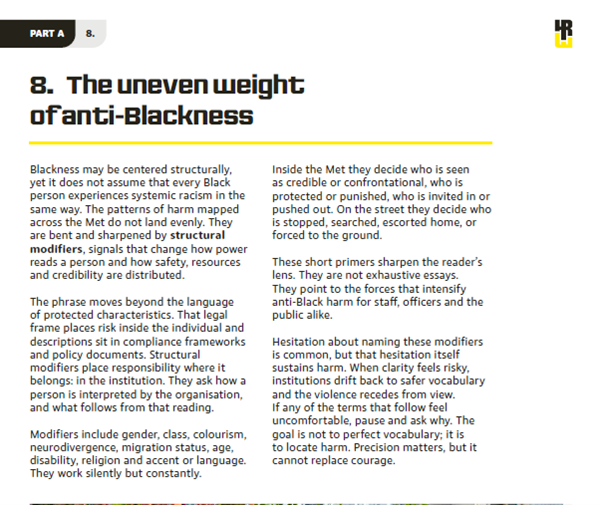
Source: 30 Patterns of Harm: A Structural Review within the London Metropolitan Police Service (pp. 17)
It was also a deliberate attempt to shift the focus away from interrogating the person, which invariably places the burden on the individual to “behave differently” to make them less of a target for harm.
Organisations do not encounter people neutrally, i.e. “I have no opinion either way”.
They interpret them.
They make judgments about credibility, risk, vulnerability and authority.
And when those judgements are already shaped by assumptions about Blackness, about who looks credible, who looks suspicious, who appears to belong in positions of authority, the consequences that follow cannot reasonably be blamed on the individual being judged.
And those judgments do not just sit in someone’s head. They show up in decisions. Who gets hired? Who gets given the benefit of the doubt? Who is seen as leadership material? Who is described as “not quite ready yet”. Who is labelled intimidating, difficult, aggressive, confrontational, or not a cultural fit?
And over time, those small judgments accumulate. They shape who gets stretch assignments, who gets informal sponsorship, who is trusted with responsibility, and ultimately who moves into positions of leadership.
In policing, the patterns become irrefutable, provided you know how to see clearly.
Inclusion cannot fix a structural problem
This is not about attacking DEI as a concept, before anyone comes for me. Here, I’m explaining its structural limitations.
Firstly, DEI, as a field in itself, is not usually designed to diagnose structural harm or stress-test organisational weaknesses. Most (and be clear, I am not saying all), DEI work is built around representation, awareness, culture and behaviour. Those things are important, but they are not the same as understanding how racial harm is produced and reproduced by organisational systems.
Secondly, DEI tends to work through programmes and initiatives. Training. Employee networks. Policy reviews. Listening exercises. Cultural competency work. Again, none of these is unimportant. But they operate largely at the level of people and culture rather than at the level of institutional or organisational design and governance.
And thirdly, it is typically positioned outside the organisational power centre. So even if you have people in these roles who care deeply about this work and understand the ways in which systemic racism is enabled at a structural level, they very rarely control the levers that shape outcomes.
For example, those levers are things like:
operational decision-making
resource allocation
budget allocation (if they are lucky enough to get a budget)
governance structures
organisational priorities
performance frameworks
procurement decisions
narrative control (what leaders publicly name as a problem)
Specificity matters when addressing systemic racism because you have to examine where power actually sits in the organisation and how decisions are made. You have to identify what factors, belief systems, and racialised assumptions are shaping those decisions, how risk is being interpreted and where patterns of racial harm appear over and over again, even when intentions are good.
This is not typical DEI work.
So again, I am saying this: If the causes of racial harm sit in governance, decision-making, power and organisational design and development, then locating the response in a function that does not understand, address or control those levers will never produce the depth of structural change that is needed to eradicate decades of persistent racial harm, discrimination and violence.
Leaders are rarely incentivised to sit in discomfort and move regardless
Until we are able to challenge the thinking, belief systems, and unsaid calculations that shape how leaders approach this work, we will continue to assume that inaction is down to ignorance, “we don’t know what we don’t know” alone.
In reality, it is often something else entirely.
A mixture of internal and external pressures that sit broadly under two very human instincts: self-interest and organisational survival.
It may feel slightly uncouth to say this out loud, but those pressures show up in ways that are both ordinary and predictable. Let me give you some brief examples.
1. Career considerations
In the immediate aftermath of the 2020 global protests, being publicly associated with anti-racism work was widely seen as a positive signal. It suggested moral clarity, organisational awareness and leadership courage. For many people, particularly those not directly impacted by racism themselves, it was also understood as something that enhanced one's professional reputation and standing as a “good ally”.
That moment has passed, and now leaders ask themselves: If I take on this work publicly, how will it affect my ability to progress in this organisation? Is this still the kind of issue people get rewarded for championing, or will it make it more difficult for me to be promoted? Is it still “good for my career” to be associated with this work?
Invariably, at some point, the allies disappear. They are strategically moved into new roles, maybe even promoted, as doing the "Black thing" became a way to earn their stripes until they demonstrated cultural competency and could therefore tick that off to enhance their CV.
Blackness as capital and currency to be traded by non-Black people is another conversation that needs to be had. Particularly in the sphere of "ally-ship", but I'll come back to that at another time.
Possibly.
2. Pension timelines and post-retirement opportunities
Many of the most senior leaders in large institutions and organisations are closer to retirement than they are to the start of their careers. That reality shapes decision-making more than people are often willing to admit. If someone has spent twenty to thirty years navigating an organisation successfully, the question becomes: Is this really the moment to start challenging the institution in a way that rocks the boat?
Some may decide that, because they only have a few years left, it doesn’t make sense to go out on a limb; instead, they hunker down and accept the status quo with resignation.
By the same token, some leaders rarely disappear after retirement. They move into advisory roles, board appointments, high-paid consultancy work, or industry leadership positions. Those opportunities are often shaped by how they are perceived by their peers.
Thus, if they feel that the political headwinds are not on the side of justice and fairness, they will also be thinking about the implications of being associated with the work, and, again, making calculated decisions based on comfort, ease, and potential blowback that might hurt their post-institutional prospects.
3. Loyalty to white colleagues
I know we don’t like talking about this, but it is a real thing.
In many institutions and organisations, Black colleagues remain a statistical minority. That means championing work designed to address anti-Black racism can sometimes feel, to some leaders, like taking sides against colleagues who look more like them.
It is not always said this bluntly of course. But the underlying sentiment can sound something like: “What about….?” “Is it fair to focus so much attention on one group?” What will my colleagues think if I push this too far?
Am I wrong?
More conversations, more delaying tactics
So, bring it back full circle, this is why the Met’s proposal to fold anti-racism work into a broader inclusion strategy is so ill-advised.
Despite the reams of paper containing reviews, reports, surveys and studies, let’s do away with the notion that we lack evidence to address the problem.
Given the details of the 30 Patterns of Harm report and the Structural Companion guide, let’s also do away with the idea that the Met does not know what to do.
We are, as I was quoted, kicking the ball into the long grass. Why? Because more consultations and discussions will be held. New structures will be discussed. New subject matter experts to be appointed. More suggestions for new language. More debates about titles and framing.
Meanwhile, harm continues, exactly as it always has been.
When people continually ask – why is racism so difficult to address at its roots, this is why.
This is what delay looks like in practice. Never outright refusal, just another conversation with more “concerns” to be tabled to drag out the process of substantive action.
The Met is not alone in this.
Many organisations that made strong commitments to tackling systemic racism in 2020 have capitulated to right-wing rhetoric, even as they tell themselves it was for legitimate reasons.
But the problems those commitments were meant to address have not disappeared. The data continues to prove the point. The complaints still surface. The same patterns continue to show up.
Confronting systemic racism requires leaders at all levels, and even colleagues themselves, irrespective of racial identity, to examine how their own decisions, assumptions and everyday habits and behaviours may have contributed to the very patterns they now say they want to fix.
That is not an easy position to occupy.
It requires people to accept that racial harm can occur even when intentions are good.
For many people, that still remains a profoundly uncomfortable place to sit, and that discomfort means we perpetually go in circles all the while claiming we take a "zero tolerance approach to racism."
Listen to our podcast
Advancing Racial Equity 4.0 curates the best conversations with business, legal, management and racial equity experts and activists to help you understand how to address systemic racism within your workplace and why it matters.
Find more episodes of Advancing Racial Equity 4.0
Discover thought-provoking HR rewired articles
Read the book and download our free digital discussion guide
Complete our free Structural Readiness Assessment to assess the extent to which your approach is addressing the structural roots of harm.