
Note: Unless otherwise stated, all page and paragraph references throughout this statement refer to the Fairfield Independent Review of the Metropolitan Police Service (2026).
I am appreciative of Dr Gillian Fairfield's independent review and its examination of the progress made by the Metropolitan Police Service since Baroness Casey's review in 2023.
To be clear, Fairfield's remit was considerably broader than systemic racism. Her review considered the Met's progress across its organisational culture, professional standards, leadership and treatment of the public. This distinction is important because 30 Patterns of Harm deliberately concentrated on systemic racism, particularly as experienced by Black officers, staff, volunteers and communities.
What I found particularly significant was that Fairfield's team did more than consider our findings. During its own examination, it encountered examples of the institutional reasoning we had identified in the 30 pattern dossiers.
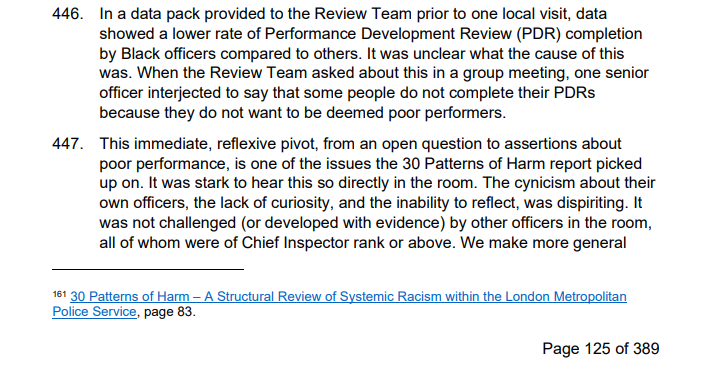
One example concerned lower appraisal completion rates among Black officers. When questioned about the disparity, a senior officer offered an unsupported explanation that placed responsibility on Black officers themselves, rather than examining what might be happening within the Met's appraisal process. Fairfield recognised this as an example of the institutional reasoning identified in 30 Patterns of Harm (p. 125, paras. 446 - 447).
That her team encountered this behaviour during a separate examination, with a much broader remit, demonstrates the continuing relevance of our structural analysis.
Source: Fairfield, G. (2026) Fairfield Independent Review of the Metropolitan Police Service.
Why are we still returning to the same findings and advice already given?
Fairfield examined the Met's subsequent “anti-racism training” and was unable to establish how it connected to the structural analysis contained within our 2025 report. Her review states:
409. The Review Team could not trace a thread from Dr Daniels’ ‘30 Patterns of Harm’ report to a subsequent strategic document which determined the nature, content and role of this training (p. 119).
Fairfield subsequently proposes that the Met revisit 30 Patterns of Harm and its Structural Companion Guide, connecting them to organisational decisions with clear ownership, resources, milestones and evidence of progress, including explaining any deviation from the institutional prompts provided (p. 146, para. 536).
This is a sensible proposal as a tactical option. However, we should find it deeply concerning that another independent review is having to direct the Met back to work it commissioned and received in July 2025. More concerning still is that while the Met is, of course, entitled to commission additional expertise as it sees fit, including consultants and organisations with different specialisms, it still had a responsibility to ensure that subsequent work was informed by evidence already in its possession. The Structural Companion Guide was specifically intended to help the Met translate the findings into its own internal reflections and subsequent prioritisation of action.
The point here is that if new work was commissioned without requiring providers to engage with that diagnosis, or demonstrate how their support would build on the existing structural analysis, the Met risked creating separate programmes that could each be delivered successfully against their individual briefs while leaving the structural problems identified in 30 Patterns of Harm untouched.
There will always be circumstances requiring further independent investigation. However, is it in the public interest to continue commissioning reviews and external support, returning to familiar findings and announcing further programmes without examining why earlier interventions have failed to produce the intended results?
That is what leadership accountability looks like. It is not always about what happened, but also what didn't happen, the decisions that were taken or avoided, and why.
There is also a responsibility here for MOPAC and the London Policing Board. Oversight needs to do more than receive progress updates and assurances. It must be capable of examining whether the Met's decisions are actually changing, recognising when explanations offered by its leadership require further challenge, and knowing when continued failure to address identified problems must be formally escalated. Otherwise, the Met can continue reporting on its progress without ever being required to account for why the same problems persist or what consequences should follow when its response remains inadequate.
Racial harm doesn’t pause while an organisation “reflects” on what it intends to do
One difficulty that became increasingly apparent during our work with the Met was that identifying how racial harm was being reproduced did not mean those responsible for the organisation understood their own contribution to it.
That requires more than explaining terminology, raising awareness or teaching people about the history of racism. Leaders must learn to question conclusions they have previously accepted as reasonable, particularly when those conclusions influence decisions affecting Black people.
Fairfield also recognises that our findings have implications for the Met's overall leadership, beyond those responsible for tackling racism ( p. 278, para. 1158).
There is a difference between holding leaders responsible for delivering an action plan and requiring them to examine how their own decisions may have contributed to the problems the plan is intended to address. The latter cannot simply be delegated to those managing race action plans or operationalising inclusion strategies.
The Met, and institutions alike, must learn how to examine themselves as a continuous discipline, not a one-off exercise when something happens or external scrutiny provides pressure.
Commissioning Black expertise requires more than appointing us as experts
Fairfield also documents the circumstances surrounding the conclusion of HR rewired's engagement with the Met (pp. 128 – 130).
Our team was, and remains, predominantly Black. We were commissioned to examine institutional assumptions through which Black people can be disbelieved, dismissed or treated as less credible purely because there is a discomfort with our tone or delivery. It would be unreasonable to assume those same conditions could have no bearing on how Black professionals undertaking any form of work connected to systemic racism would be insulated from that.
The governance conditions I sought from the Met at the time were important to both the integrity of the examination and as a form of safeguarding for our protection. Particularly as we often become the targets of defensiveness, hostility and aggression when trying to undertake deep systemic work of this kind. Whilst I can understand why, it doesn’t mean we should accept that treatment.
Executive sponsorship cannot simply mean that a senior leader is passively “okay” with the work taking place. They must be prepared to engage with uncomfortable findings and take responsibility for the decisions that follow.
There is also a wider question about the authority and respect given to Black expertise.
Casey's findings are rightly and frequently referenced. Yet our subsequent work, commissioned to explain why systemic racism continued and how the Met could examine its own contribution, has not consistently received the same attention. Not because we are courting publicity but because the findings are instrumental in redirecting energy to the institutions as the site of harm, rather than always putting the people most impacted under the microscope (only to disbelieve their evidence and testimony or not act on what they repeatedly share).
I maintain the Met should not have needed another independent review to recognise the importance of work it had specifically commissioned and would be curious about why there felt so unable to engage with it in a meaningful way when it was first presented to them.
Why we centre Black experiences
We are frequently asked why our work centres the experiences of Black colleagues and communities when other groups also experience forms of discrimination.
Our view is this: the Black experience for want of a better phrase, provides a particularly revealing test of organisational health because it is often where the distance between an organisation's stated values and commitments and people's actual experiences is widest.
Examining anti-Blackness does not remove the need to understand misogyny, homophobia or other forms of discrimination. However, the organisational conditions that allow racial harm to become normalised absolutely affect how other people are treated.
This is also relevant to the wider policing reform agenda. As policing faces the prospect of significant reform, we must also address the ways in which those very institutions continue to be sites of harm. Reform must also specifically address that too.
For the Met, progress must ultimately be judged by whether Black officers, staff, volunteers and communities experience a meaningful difference in how they are treated, rather than by how much activity the organisation can report having undertaken.
And finally…
The Commissioner has accepted Fairfield's overarching recommendations. What is critical now is whether that acceptance leads to different decisions and an ongoing willingness to examine how the Met itself operates.
We must also be prepared to ask a more fundamental question. The Met's size, complexity and the difficulty of confronting systemic racism have repeatedly been cited to explain why meaningful change takes time. Some of those difficulties are real. But given the findings of successive independent reviews, including Casey, 30 Patterns of Harm and now Fairfield, at what point do we question whether the Met, in its current structure, is capable of addressing the systemic failures that continue to undermine its legitimacy?
This is not to dismiss the progress made in particular areas, Fairfields review is clear on where she has seen progress. But policing by consent depends on maintaining public trust and being responsible for how discretionary power is exercised.
Complexity may be a genuine explanation for why reform is difficult, however, it cannot, indefinitely, become a permanent justification for a lack of courageous leadership and continuing with programmes and initiatives that are not embedded as business-as-usual and delivering as judged by the people most impacted rather than the institution itself.
Dr Shereen Daniels
Author and Managing Director HR rewired
References and further reading
Fairfield, G. (2026) Fairfield Independent Review of the Metropolitan Police Service. Read the report.
Daniels, S. (2025) 30 Patterns of Harm: A Structural Review of Systemic Racism within the Metropolitan Police Service, and A Structural Companion Guide. Access both reports.
Daniels, S. (2025) 30 Patterns of Harm: How this report should be read. Access here.
Daniels, S. (2026) A Moment of Opportunity? Analysis of the Home Office's proposed national policing reforms. Access here.
About HR rewired
HR rewired is an independent HR consultancy specialising in the structural examination of systemic racism and institutional harm. Led by Dr Shereen Daniels, its work helps complex organisations and institutions understand how leadership decisions, governance arrangements and everyday practices contribute to persistent harm, and what must change to address those conditions at its structural roots.
Website: www.hr-rewired.com